Repelling sparrows can be difficult because they are small, highly adaptable birds that can easily find food, shelter and nesting areas. There is no single solution that works for every situation. A sparrow problem in a warehouse is not the same as a problem on a terrace, roof, farm, garden or area with feed or grain.
In this guide, we explain how to repel sparrows effectively and responsibly, which methods may help in each situation, which mistakes should be avoided and which professional solutions can be considered when the problem is already established.
- What to know before repelling sparrows
- What problems sparrows can cause
- What to do before installing a sparrow repeller
- Methods to repel sparrows
- Why we do not recommend using poison for sparrows
- What to do if there are sparrow nests
- Frequently asked questions
Before Repelling Sparrows: What Should We Know?
Sparrows are very common birds in towns, cities, farms, gardens, terraces, warehouses and agricultural environments. Because they live so close to humans, the problem often appears gradually: first they perch in an area, then they find food or shelter and, if the conditions are favourable, they may start using the area regularly.
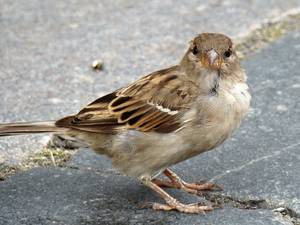
- They are small birds. This allows them to enter through gaps, cracks, gutters, eaves, doors or spaces that larger birds would not access so easily.
- They are highly adaptable. They can live in urban, rural, agricultural and industrial areas as long as they find food, water or shelter.
- They move in groups. When an area is comfortable for them, they may gather in flocks and increase problems with dirt, noise and repeated presence.
- They look for easy food sources. Seeds, grain, feed, food scraps, waste or insects can attract them continuously.
- They can nest in small spaces. Eaves, cracks, roofs, false ceilings, gutters or protected areas can become shelter points.
For all these reasons, repelling sparrows is not simply a matter of placing a random product in the area. It is important to understand why they are coming and what the area is offering them: food, shelter, perching points, water or access to an indoor space.
Why Repel Sparrows: Most Common Problems
Sparrows may seem harmless when they appear occasionally. The problem starts when their presence becomes constant or when they enter areas where they create dirt, nuisance or hygiene risks.
The most common problem is droppings. They dirty surfaces, goods, furniture, machinery, terraces, roofs, gutters, vehicles and working areas. In addition, when feathers, nests or droppings accumulate, the area becomes more attractive for birds to keep returning.
Sparrows on farms and livestock facilities
On farms and livestock facilities, sparrows may be attracted by feed or grain. This can cause dirt, feed losses and hygiene problems, especially if they enter indoor areas or gather near feeders, storage rooms or feeding points.
Sparrows in vegetable gardens, crops and gardens
In vegetable gardens, crops and gardens, sparrows may feed on seeds, shoots, small fruits or food remains. In these cases, the most suitable solution depends on the surface area, the level of bird pressure and whether the problem is occasional or recurring.
Sparrows in warehouses, storage areas or factories
When sparrows enter a warehouse or storage area, the problem is usually more serious. They can access the building through doors, cracks, roofs, gaps or loading and unloading areas. Once inside, they can dirty goods, pallets, machinery, packaging or working areas.
In these cases, it is not enough to think only about repelling them. It is also important to reduce the conditions that allow them to remain inside: available food, entry points, shelter areas and previous signs of bird presence.
You can read these real cases related to bird and sparrow problems in industrial environments:
- How to remove birds from a warehouse: the Inasur case.
- Sparrow infestation at Embalatges Serdá, a real case in a factory where sparrows were soiling stored pallets.
Sparrows on terraces, bars and restaurants
On bar and restaurant terraces, sparrows are usually attracted by food scraps. They may bother customers, dirty tables, chairs, awnings or floors, and return continuously if they find easy access to food.
Sparrows on roofs, gutters and buildings
In buildings, sparrows can take shelter under tiles, in gutters, eaves, façade gaps, roofs or small cracks. In these cases, in addition to deterrent methods, it may be necessary to check access points and consider physical solutions to prevent them from settling again.
Recommendations Before Installing a Sparrow Repeller
Before installing any sparrow repeller, we recommend preparing the area properly. This step is important because it helps birds stop perceiving the place as their own safe area.
- Clean the area of droppings, feathers and signs of bird presence. If there is heavy accumulation, be especially careful and use suitable protection, such as gloves and a mask.
- Remove food scraps, grain, feed or waste. If sparrows continue to find easy food, it will be more difficult for them to leave the area.
- Check gaps, cracks, doors, gutters and access points. This is especially important in warehouses, storage areas, farms and roofs.
- Do not install a product without first understanding the origin of the problem. A terrace with food scraps does not require the same approach as a warehouse where sparrows are entering through loading doors.
- Combine methods when the problem is persistent. In many cases, a single measure will not be enough in the long term.
How to Repel Sparrows: Methods and Solutions
Sparrows are very persistent birds and can be difficult to repel completely. The realistic objective is usually to reduce their presence, make it harder for them to settle and keep the problem under control so that it does not get worse.
The most suitable solution will depend on the environment, the surface area to be protected and the level of bird presence. Below we explain the most common methods.
Sound sparrow repellers
Sound repellers are one of the most commonly used solutions when the sparrow problem affects large areas, warehouses, farms, storage facilities, crops or spaces where audible sound is viable.
BirdGard units with chip #62 are configured to work specifically against sparrows. They emit audible sounds, such as alarm calls, predator sounds and other acoustic stimuli, with the aim of creating a sense of risk in the protected area.
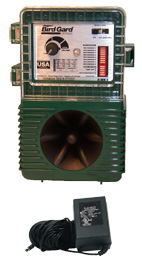
There are different models depending on the surface area you need to protect:
- BirdGard Pro #62: suitable for areas of up to 0.6 hectares.
- BirdGard Pro Plus #62: suitable for areas of up to 1.2 hectares.
- BirdGard Super Pro #62: suitable for areas of up to 2.4 hectares.
- BirdGard Super Pro Amp #62: suitable for areas of up to 12 hectares.
- MultiSound BS-20L: can be considered in professional environments, especially when the problem is not limited only to sparrows or when a multi-bird acoustic solution is needed.
These units should not be presented as a magic or immediate solution. Their effectiveness improves when they are installed correctly, programmed properly and combined with previous cleaning of the area and, when appropriate, with visual or physical methods.
Visual sparrow deterrents
Visual deterrents can help reinforce the deterrent effect, especially when they simulate natural predators and include movement. In the case of sparrows, visual stimuli usually work better as a complement than as the only measure in persistent problems.
The Hawk ScareCrow – Eolo is a kite that simulates the flight of a hawk and can be useful in outdoor spaces, roofs, agricultural areas or warehouse access points. It can also complement sound repellers, reinforcing the threat message for the birds.
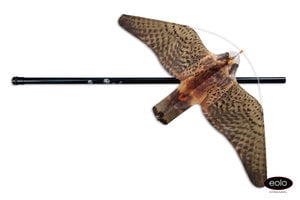
The combined effect of sound and visual stimuli can improve the effectiveness of the solution: sparrows hear alarm or predator sounds and, at the same time, see a visual threat in the area. This combination is usually stronger than using a single isolated method.
Other visual elements can also be considered, such as the Prowler Owl, especially in more localised cases. It is advisable to move these elements from time to time to reduce the risk of habituation.
Ultrasonic devices for sparrows
We do not recommend ultrasonic devices as the main solution to repel sparrows. In particular, we do not recommend UltraSonX for this type of problem, as sparrows usually respond better to solutions that combine audible sounds, visual stimuli and physical measures depending on the case.
In warehouses, roofs, open areas or places with food and shelter, it is usually more appropriate to consider audible sound repellers, visual methods, physical barriers or a combination of systems. If you are looking for a solution that includes ultrasonic technology, we recommend considering BroadBand Pro, as it combines audible sounds and ultrasonic technology in a single unit.
Laser technology to repel sparrows
Laser technology can be useful to repel sparrows in specific cases, especially in industrial environments, indoor areas, roofs, warehouses or areas where birds gather in specific points. However, it should not be considered a universal solution or the first option for every sparrow problem.
The laser usually works best when the deterrent effect can be directed in a controlled way towards a specific perching, shelter or passage area. In the case of sparrows, because they are small, fast and often dispersed birds, its application can be more limited than with larger birds or more compact flocks.
For this reason, laser technology may make sense when sparrows are concentrated in a warehouse, factory, storage area, roof or semi-indoor area where other methods are not sufficient or cannot be applied easily. However, if the problem is very dispersed, food is available or there are many access and shelter points, it will normally be necessary to combine it with previous cleaning, access control, sound repellers, visual stimuli or physical barriers.
An example of use in an industrial environment is the Embalatges Serdá case, where a sparrow infestation in a factory was treated because sparrows were soiling the pallets manufactured and stored by the company. That article mentions the Bird Lazzzer product. This product has been replaced by the Bird Laser Repeller, which is the current reference available in our store.
To see the available solutions, you can visit our laser bird deterrents category.
Physical barriers and anti-perching solutions
When sparrows take shelter in gaps, eaves, gutters, roofs or specific perching areas, it may be necessary to use physical barriers or systems that make access more difficult. In these cases, the priority is not only to scare the bird, but to prevent it from continuing to use the same point as a shelter, resting area or nesting site.
For specific points where sparrows usually perch, anti-perching gels can be a very effective solution. This type of product creates an uncomfortable surface for the bird, helping to reduce perching on ledges, beams, structures, edges, sills or localised areas where birds keep returning.
Within this type of solution, you can consult our anti-perching solutions for birds category, where we group products designed to protect specific perching, access or shelter points.
If the problem is related to birds taking shelter or trying to nest under solar panels, it is advisable to use a specific solution such as BirdBlocker, designed to close access under photovoltaic panels.
Is It Recommended to Use Poison for Sparrows?
No. We do not recommend using poison for sparrows under any circumstances. In addition to being a dangerous and irresponsible practice, it can pose a risk to other birds, pets, non-target wildlife, people and the environment.
Using poison does not solve the cause of the problem. If the area continues to offer food, shelter, water or nesting points, other sparrows may return to occupy the same space. Therefore, in the case of a persistent presence, the solution should not focus on eliminating birds, but on correcting the conditions that attract them: removing food scraps, cleaning the area, reducing access to grain or feed, closing entry points when appropriate and using suitable deterrent methods or physical barriers.
It is also important to bear in mind that sparrows are wild birds and that their capture, killing, harm or the destruction of nests may be prohibited or require authorisation depending on the applicable regulations. For this reason, if there is a serious health, safety or hygiene problem, it is advisable to consult a professional or the competent authority before taking any action.
At BirdGard Iberia, we work with bird control solutions focused on deterrence, prevention and space protection, not on the use of poisons, chemical products or lethal methods.
Can Sparrow Nests Be Removed?
Before removing a sparrow nest, it is advisable to check whether it is active and whether it contains eggs or chicks. It is also important to act in accordance with the applicable regulations in each case and, if in doubt, consult a professional or the competent authority.
If the nest is not active and can be legally removed, it is advisable to clean the area properly afterwards and apply preventive measures to stop sparrows from using the same point again. If the nest is removed but the gap, shelter or access point remains, the problem may reappear.
In areas such as eaves, roofs, gutters, false ceilings, beams, ledges or façade gaps, it may be necessary to combine cleaning, closing access points and deterrent methods. For specific points where sparrows perch or try to nest again, anti-perching gels can be a very useful solution.
One option to consider is AviFin Gel, designed to protect localised perching areas. This type of product creates an uncomfortable surface for the bird and helps prevent it from using the same point as a regular resting, perching or nesting area.
Which Solution Should You Choose?
Not all sparrow problems require the same approach. As a general guide:
- Sparrows in warehouses, farms or storage areas: consider sound repellers, previous cleaning, reduction of available food and visual reinforcement at access points or roofs.
- Sparrows on roofs, gutters or eaves: check shelter points and consider physical barriers, anti-perching systems or visual methods.
- Sparrows on patios, gardens or terraces: remove food scraps and consider visual or localised solutions if the problem is moderate.
- Sparrows in industrial areas: study whether the problem is related to access, perching, stored goods or the presence of food.
- Sparrows under solar panels: use a specific solution to prevent access under the panels.
If you want to see the available solutions, you can visit our sparrow repellers category.
Conclusion: How to Repel Sparrows Effectively
To repel sparrows effectively, the most important step is to analyse the specific case. Sparrows may be attracted by food, shelter, perching points, access to a warehouse or the possibility of nesting. If the cause is not corrected, any solution will have more difficulty working in the long term.
In persistent problems, it is usually advisable to combine cleaning, reduction of available food, access control and deterrent methods such as audible sounds, visual elements, laser technology, physical barriers or mixed solutions depending on the environment.
You can find all available products in the BirdGard Iberia online store: sparrow repellers.
If you are not sure which solution is best for your case, you can contact BirdGard Iberia for advice: contact BirdGard Iberia.
Frequently Asked Questions About How to Repel Sparrows
What is the best sparrow repeller?
It depends on the location and the type of problem. For warehouses, farms, storage areas or large surfaces, sound repellers usually fit better, especially when combined with visual elements. In this type of case, BirdGard units with a specific sparrow chip or multi-bird acoustic solutions such as MultiSound BS-20L can be considered. For specific access, shelter, nesting or perching points, physical barriers, anti-perching systems, anti-perching gels or specific solutions to close access to the area may be more suitable.
Can sparrows be repelled completely?
Sparrows are highly adaptable birds and can be difficult to repel completely. The realistic objective is usually to reduce their presence, make it harder for them to settle and keep the problem under control so that it does not get worse. To achieve this, it is usually necessary to act on several causes at the same time: available food, shelters, access points, previous signs of bird presence and regular perching areas.
Do ultrasonic devices work to repel sparrows?
We do not recommend them as the main solution for sparrows. In particular, we do not recommend UltraSonX for this problem. If you are looking for a solution that includes ultrasonic technology, it is preferable to consider BroadBand Pro, which combines audible sounds and ultrasonic technology, always within a strategy that also considers the environment, cleaning, available food and possible visual or physical methods.
Is it recommended to use poison for sparrows?
No. We do not recommend using poison for sparrows under any circumstances. In addition to being a dangerous and irresponsible practice, it can affect other birds, pets, non-target wildlife, people and the environment. It may also conflict with wild bird protection regulations.
Poison also does not solve the cause of the problem. If the area continues to offer food, shelter, water or nesting points, other sparrows may return. For this reason, the solution should focus on removing the elements that attract them, cleaning the area, controlling access and using suitable deterrent methods or physical barriers.
Can sparrow nests be removed?
Before removing a nest, it is advisable to check whether it is active and whether it contains eggs or chicks. It is also important to act in accordance with the applicable regulations and, if in doubt, consult a professional or the competent authority.
If the nest is not active and can be legally removed, the area should then be cleaned properly and preventive measures should be applied to stop sparrows from using the same point again. In specific perching or nesting attempt areas, anti-perching solutions such as AviFin Gel – Bird Repellent Gel can be considered. It may currently be temporarily out of stock, but its product page allows you to check availability, technical information, application method, videos, reviews and future restocking.
How can sparrows be prevented from entering a warehouse?
It is advisable to check access points, doors, cracks, gaps, roofs and loading and unloading areas. It is also important to reduce the availability of food, clean signs of bird presence and consider sound repellers reinforced with visual elements outside the building or at entry points. If the problem is already established, results may not be immediate and several measures may need to be combined.
Is it advisable to combine several methods against sparrows?
Yes. In persistent problems, it is usually better to combine cleaning, food control, sound, visual stimuli, physical barriers and anti-perching solutions rather than relying on a single measure. The combination reduces the risk of habituation and makes it possible to act on several causes of the problem: why they enter, where they perch, where they find food and which points they use as shelter.