When signs of rats or mice appear, it is not always easy to know which product to use. An electronic repeller, a live-catch trap and an electric trap work in very different ways and are designed to achieve different results.
The choice depends on four questions: do you want the rodents to leave the area, catch them alive or eliminate them? Are you dealing with a rat or a mouse? Where have you detected activity? Is it an isolated incident or an ongoing problem?
Quick answer: which rat or mouse control solution should you choose?
If you want rodents to leave an area or prevent them from returning, use an electronic repeller. If you need to remove a rat or mouse without killing it, choose a correctly sized live-catch trap. If you need to eliminate a rodent in a dry indoor area without poison, an electric trap is the most direct option.
This table summarises our recommendations for the most common situations:
| Situation | Objective | Recommended solution |
|---|---|---|
| There is frequent activity in a garage, warehouse, plant room or large indoor area | Encourage rodents to leave the area | WK0600 repeller |
| Activity has stopped and you want to prevent their return | Maintain quiet, preventive protection | Duo Gardigo repeller |
| There are mice in a suspended ceiling or a small area without a power socket | Repel mice without a mains power supply | Battery-operated mouse repeller |
| Rodents are entering the engine compartment | Protect wiring, hoses and insulation | Weitech WK0508 |
| You have located a rat indoors or outdoors and want to remove it alive | Catch a larger rodent | Live-catch rat cage |
| A mouse has entered and you want to remove it alive | Catch it in a small, reusable trap | Gardigo live mouse trap |
| You want to eliminate rats or mice in a dry indoor area | Act directly without rodenticides | Weitech WK0650 electric trap |
| There are many rodents, persistent activity or a serious infestation | Identify the cause and implement an ongoing control plan | Professional pest control company |
An electronic repeller and an electric trap are not the same
Terms such as ‘electric repeller’, ‘electronic repeller’ and ‘electric trap’ are often used interchangeably, but they describe different products.
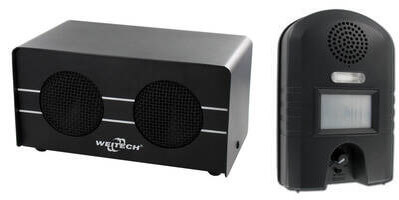
An electronic rat and mouse repeller is mains- or battery-powered and emits ultrasound, audible sound or other signals intended to make the environment uncomfortable for rodents. It does not catch or electrocute them: its purpose is to encourage them to leave or make the area less attractive to them.
A live-catch trap holds the animal inside a cage or container. It keeps the rodent located so that it can be removed rather than dying in a hidden place, but you must choose the correct size, position it on a travel route and check it very frequently.
An electric rat and mouse trap attracts the rodent inside and eliminates it with an electric shock when it contacts the metal plates. The animal remains inside the device, located and ready to be removed.
| Method | What it achieves | When it is most suitable | What it does not do |
|---|---|---|---|
| Electronic repeller | Deters rodents and encourages them to leave | Prevention or activity in specific indoor areas | Does not catch or eliminate rodents |
| Live-catch trap | Holds a rat or mouse alive | An isolated occurrence or a few rodents in a known indoor or outdoor area | Does not prevent further rodents from entering |
| Electric trap | Eliminates the rodent inside the device | Rats or mice present in dry indoor areas | Does not prevent other rodents from entering |
No single method is always best. The right solution is the one that matches your actual objective and the conditions in the area.
When we recommend an electronic rat and mouse repeller
Repellers are suitable when you want rodents to leave an area or prevent them from returning. They are particularly useful in garages, warehouses, storage rooms, suspended ceilings, plant rooms and other indoor areas where you do not want to use poison.
If there is frequent activity: WK0600

If you frequently hear noises, find fresh droppings or notice recent damage, we recommend the WK0600 Rodent and Insect Repeller.
It has three operating modes. Quiet uses ultrasound only, while Med and Loud add audible sounds to increase the deterrent pressure. The audible modes are therefore more suitable for warehouses, garages, plant rooms or other places where they will not disturb people.
The stated coverage is up to 325 m², but this should be regarded as a maximum reference. The layout, walls, furniture, boxes and other obstacles all affect the way sound and ultrasound travel.
In our article about how to deter mice we describe a real case in a country house and the measures we used alongside the WK0600 to prevent the problem from returning.
If you want to prevent their return: Duo Gardigo

If you are no longer detecting activity and want a preventive measure that can run continuously without audible disturbance, we recommend the Duo Gardigo Mouse Repeller.
It combines variable ultrasound with electromagnetic waves and has a stated coverage of up to 550 m². It is designed to remain connected continuously and help make the area less attractive to mice and other small rodents.
If there is no power socket or the problem is in a suspended ceiling

For suspended ceilings, sheds, storage rooms and small areas without a nearby power socket, the Battery-operated mouse repeller may be the more practical option.
It uses four AA batteries, emits ultrasound and has a stated coverage of up to 40 m². In a suspended ceiling, it must be placed inside the ceiling void itself, in a dry location with no obstacles directly in front of the emitter.
This model is intended primarily for mice and small spaces. If you suspect rats, the area is larger or activity is intense, consider the WK0600, a suitable trap or a professional inspection.
If rodents enter the car engine

Rats, mice and other rodents may shelter in the engine compartment and gnaw wiring, hoses and insulation. For this situation, we recommend the Weitech WK0508 Car Rodent Repeller.
It combines variable ultrasound and flashing LEDs and connects directly to the vehicle’s 12 or 24 V battery. Install it according to the instructions, away from moving parts and high-temperature areas. For more information, see our guide to rats and mice in cars.
An important limitation of ultrasound
Ultrasound does not pass through walls, doors, floors or ceilings. It can also be blocked by boxes, furniture, machinery and other solid obstacles.
For this reason, placing a repeller in one room will not protect an adjacent room. In a suspended ceiling, it must be installed inside the ceiling void; in a divided warehouse, more than one unit may be needed; and in an area with extensive shelving, point the emitter towards the activity area and keep the space in front of it clear.
A repeller is not a substitute for removing food or sealing entry points. If rodents continue to find food, water and shelter, they have more reason to remain.
To understand in more detail how these waves work, the difference between audible sound and ultrasound, and why positioning matters, read our guide to ultrasonic animal repellers.
When we recommend a live-catch trap for rats or mice
Live-catch traps are suitable when you know there are one or a few rodents in a specific area and want to locate and remove them without poison. They also provide clear confirmation that a rodent has been caught.
Live-catch cage traps can be used both indoors and outdoors. Outdoors, they must be placed on a stable surface in a location protected from rain, direct sunlight and extreme temperatures, and checked very frequently.
The size difference between a rat and a mouse matters: a mouse trap may be unsuitable for a rat, while an oversized cage may not be sensitive enough for a small mouse.
Live-catch trap for rats

To catch a rat alive, we recommend the Rat Cage. It is a robust, reusable metal cage. The animal enters for the bait, activates the mechanism and the door closes, keeping it safely contained in the cage.
This option is particularly suitable when a specific rat has been detected in a garage, warehouse, plant room, garden, patio, porch, shed or another accessible location where the trap can be checked frequently.
Live-catch trap for mice

For mice, we recommend the Gardigo Live Mouse Trap. The mouse enters the container and is caught alive. Its transparent housing makes it easy to see whether a catch has occurred, and the trap can be reused after cleaning it according to the instructions.
For information on the differences in size, operation and use between models, see our comparison of animal trap cages. If you use one of the folding models, you can also follow our step-by-step folding trap cage assembly instructions.
To see the products available for each species, browse our rat traps and mouse traps.
Where to place a live-catch trap
Rats and mice usually travel close to walls and objects that provide cover. To improve the chances of a catch:
- Look for droppings, gnaw marks, nesting material and regular travel routes.
- Place the trap beside a wall or near the activity area, indoors or outdoors, without obstructing its entrance.
- Put the bait in the position specified by the manufacturer so the animal has to trigger the mechanism.
- Avoid repeatedly moving the trap while there are still signs of activity along that route.
- If used outdoors, choose a location sheltered from rain, direct sunlight and extreme temperatures.
- Check it very frequently and never leave it unattended for long periods.
- Keep the trap out of reach of children and pets.
A live catch must be handled responsibly and in accordance with the regulations that apply in your area. If you are unsure what to do with a captured animal, contact your local authority or a specialist company.
When we recommend an electric trap for rats and mice

An electric trap is different from a live-catch trap. It is designed to eliminate the rodent inside the unit and is suitable when rats or mice are present in a dry indoor area and you want to act without poison.
Unlike live-catch cage traps, an electric trap must not be used outdoors: it is designed exclusively for dry indoor areas.
The Weitech WK0650 Electric Rat and Mouse Trap delivers a 5,000 V shock when the animal enters and contacts the metal plates. It uses four 1.5 V C/LR14 batteries, and an indicator light signals when a catch has occurred.
Where can it be used?
The WK0650 is intended exclusively for dry indoor areas, such as:
- enclosed garages;
- storage rooms;
- warehouses;
- plant rooms;
- indoor rodent travel routes.
Do not use it outdoors, in wet areas or anywhere it could be exposed to rain, condensation or splashes. Keep it out of reach of children and pets, and always handle it in accordance with the manufacturer’s instructions.
How to position an electric trap
Place it on a stable, dry surface near a wall or along the route used by the rodents. Use only the bait and quantity specified in the instructions, taking care not to cover or soil the contact plates.
Switch the device off before opening or cleaning it or removing a catch. Check the indicator regularly and follow the hygiene and maintenance instructions to keep the trap in good condition.
Traps and repellers versus poison
Authorised rodenticides may form part of certain professional control programmes, but many customers prefer a poison-free solution for homes, garages, warehouses and places where children, pets or wildlife could reach the bait.
Repellers and traps also offer an important practical advantage: they reduce the risk of a rodent consuming poison, moving away and dying inside a wall, ceiling void, duct or another inaccessible location. When this happens, the carcass can cause unpleasant odours that are difficult to locate and eliminate.
A repeller is intended to make the rodent leave the area. With a live-catch or electric trap, the animal remains inside the device, so you know where it is and can remove it.
Simply installing a device is not enough. Long-term control also requires action on the factors that attract rodents and allow them to enter.
Can repellers and traps be combined?
Yes, provided that each product has a clear purpose. If rodents are already inside, traps can be placed on routes where activity has been detected. A repeller can help make the rest of the area less favourable and discourage further occupation.
In a very small room, placing a baited trap directly in front of a repeller may be counterproductive: one product is trying to attract the animal to a specific point while the other is intended to make it uncomfortable. In that case, prioritise catching the rodents already present and use the repeller as support or as a preventive measure once activity is under control.
How to prevent rats and mice from returning
Rodent prevention and control involve more than installing a product. Pest management should be treated as an ongoing environmental health measure, with assessment and review of the actions taken.
To reduce the likelihood of the problem returning:
- Remove food sources. Keep food, animal feed, seeds and waste in sealed containers.
- Remove water sources. Repair leaks and prevent water from collecting in containers or other areas.
- Reduce harbourage. Remove cardboard, piles of materials and objects that remain undisturbed for long periods.
- Identify and seal entry points. Check cracks, ill-fitting doors, vents, cable and pipe penetrations, downpipes and roof junctions.
- Deal with rodents already inside first. Before permanently sealing entry points, make sure no rodents remain trapped inside.
- Clean signs of activity safely. Wear gloves, dampen and disinfect droppings before removing them. Do not sweep or vacuum them while dry, as this can disperse particles into the air.
- Monitor the area. Check for fresh droppings, gnaw marks, noises or nesting material.
Sealing entry points, removing food and using the right product are complementary measures. If only one is applied, the problem is more likely to return.
When to call a professional pest control company
Products intended for direct use may be suitable for isolated problems in specific areas. However, we recommend calling a professional pest control company when:
- you see numerous rodents or large quantities of droppings;
- activity continues after preventive and control measures have been applied;
- rodents have entered ducts, voids or areas that cannot be inspected;
- the problem affects a residential building, food business, livestock facility, healthcare setting or another sensitive site;
- there are electrical risks, structural damage or a potentially serious health issue;
- the species, entry route or scale of the infestation cannot be identified.
In these cases, inspection and follow-up are just as important as the product used.
Frequently asked questions about rat and mouse traps and repellers
Which is better for rats: a trap or a repeller?
It depends on your objective. If you want rats to leave an area, use a repeller suitable for rats. If you need to remove a specific rat, choose a correctly sized cage trap. If you need to eliminate it in a dry indoor area without poison, consider an electric trap.
What is the difference between an electronic repeller and an electric trap?
An electronic repeller emits audible sound, ultrasound or other signals to deter rodents, but it does not catch or kill them. An electric trap attracts the animal inside the device and eliminates it with an electric shock.
Can the same trap be used for rats and mice?
Not always. Rats are considerably larger and need a cage or mechanism designed for their size. For a more responsive and secure catch, use a trap suited to the rodent’s species and size.
Does ultrasound pass through walls and suspended ceilings?
No. Ultrasound does not pass through walls, doors, floors or ceilings and can be blocked by solid objects. The repeller must be installed inside the area you want to protect and positioned with no obstacles in front of it.
What can I use in a suspended ceiling without a power socket?
For mice in a small, dry suspended ceiling, use a battery-operated portable repeller placed inside the ceiling void itself. If a specific rodent has been located and the device can be checked frequently, a suitable live-catch trap may also be considered.
Where should a mouse trap be placed?
Place it near a wall, along a travel route or in an area with recent signs of activity. Avoid the centre of an open space, and put the bait in the position specified by the manufacturer so the animal has to trigger the mechanism.
Can a cage trap be used outdoors?
Yes. Live-catch cage traps can be used both indoors and outdoors. Outdoors, place them on a stable surface in a location protected from rain, direct sunlight and extreme temperatures. They must be checked very frequently so that a captured animal can be attended to promptly.
Do electric rat and mouse traps use poison?
No. The battery-powered Weitech WK0650 eliminates the rodent with a 5,000 V electric shock. It is intended exclusively for dry indoor areas and must be kept out of reach of children and pets.
How long does a mouse repeller take to work?
A repeller should not be expected to have an instant effect or replace an inspection. Results depend on positioning, the layout of the area, the availability of food and shelter, and the severity of the problem. It should remain switched on and be combined with cleaning, prevention and sealing entry points.
Can I use a repeller and a trap at the same time?
Yes, provided that each device has a role in the control plan. Place traps along activity routes and use the repeller to make the area less attractive. In very small spaces, avoid placing a baited trap directly in front of the emitter.
Summary: choose according to the result you need
There is no single trap or repeller that is best for every rat and mouse problem.
- To encourage them to leave an area: an electronic repeller suited to the area and the level of activity.
- To prevent their return: a quiet repeller and ongoing preventive measures.
- To catch a rat alive indoors or outdoors: a cage trap designed for rats.
- To catch a mouse alive indoors or outdoors: a small, responsive and reusable trap.
- To eliminate rats or mice without poison in a dry indoor area: an electric trap.
- For a serious or persistent infestation: a professional pest inspection and control plan.
At BirdGard Iberia, we have selected a range of solutions so you can act according to the species, location and objective. Browse our full range of rat and mouse repellers and traps and compare the available options.