Protecting solar panels from pigeons is not just a matter of adding mesh, spikes or any random bird deterrent. If the installation is done poorly, birds may get back in, panel ventilation may be affected, and the photovoltaic installation itself may even be damaged.
The most common mistake is thinking that the goal is simply to “scare” pigeons away. In reality, when birds are already getting underneath solar panels, the most reliable solution is usually to physically block access to the lower gap, without drilling into the panels, without blocking ventilation and without leaving open gaps.
In this article, we review the most common mistakes when protecting solar panels from pigeons and what you should do to achieve a safer, longer-lasting and more effective installation.
Why pigeons get underneath solar panels
The space between solar panels and the roof is very attractive to pigeons. It offers shelter from rain, wind, direct sunlight and some predators. It is also a relatively quiet, elevated and protected area, which can easily become a resting or nesting place.
When pigeons settle underneath solar panels, several problems can appear:
- build-up of droppings;
- nests under the panels;
- feathers, branches and organic debris;
- risk of damage to cables or connections;
- fire risk;
- bad smells and the presence of parasites;
- dirt on roofs, gutters and façades;
- recurring cleaning and maintenance costs.
That is why, when the problem is underneath the solar panels, the most important thing is to close the perimeter correctly so birds cannot get back in.
Mistake 1: using only anti-pigeon spikes
Anti-pigeon spikes can be useful on ledges, edges, beams, signs or specific areas where birds perch. However, they are not usually the best solution to stop pigeons from getting underneath solar panels.
The reason is simple: spikes make it harder for birds to perch on a specific point, but they do not close the gap between the solar panel and the roof. If there is still open space under the panels, pigeons can continue to enter and nest there.
This mistake is especially common when there are already nests under the panels. In these cases, placing spikes on some edges does not usually solve the problem, because the birds still have access to the main shelter.
What to do: use a physical perimeter barrier that closes access under the panels. Spikes can be a complement in perching areas, but they should not be the main solution to prevent nests under solar panels.
Mistake 2: relying on owls, reflective tape or ultrasonic devices as the main solution
Plastic owls, reflective tape, shiny objects or some sound devices may seem like a simple solution, but they normally do not work in the medium term when pigeons have already found shelter underneath solar panels.
Pigeons are persistent birds and can get used to visual or sound stimuli if they realise there is no real danger. If the gap under the panels remains available, they will often return.
Ultrasonic devices and other deterrent systems can be useful in some contexts, but they do not replace a physical barrier when the goal is to stop pigeons from entering under the panels.
What to do: prioritise physical exclusion. If pigeons cannot access the gap under the panels, the problem is solved much more reliably than by trying to scare them away constantly.
Mistake 3: not cleaning before installing the protection
One of the most important mistakes is closing the perimeter of the solar panels without first cleaning the lower area. If nests, branches, feathers, abandoned eggs, droppings or organic debris remain, the problem does not disappear: it is simply trapped under the installation.
This can lead to bad smells, accumulated dirt, parasites, corrosion and hygiene problems. In addition, pigeons tend to return to areas where they have already nested, so leaving remains under the panels can make them more determined to come back.
What to do: before installing any anti-pigeon barrier, remove nests, branches, feathers and droppings. If there is a significant build-up, professional cleaning and disinfection may be advisable before closing off access.
Mistake 4: leaving small gaps in corners, sides or cable entry points
An anti-pigeon installation may look correct at first glance and still leave entry points. Pigeons can take advantage of gaps in corners, height changes, areas near chimneys, gutters, cable entry points or roof irregularities.
This is one of the reasons why some installations fail. It is not enough to protect only the most visible sections: the entire perimeter must be closed continuously.
What to do: check the full outline of the installation. Corners, sides and cable passage points must be properly protected. A small gap can be enough for pigeons to get back in.
Mistake 5: drilling into the solar panel frame
Drilling, screwing into or modifying the frame of solar panels can be a serious mistake. Some improvised installations attach mesh or barriers directly to the panel frame, but this may affect the manufacturer’s warranty, cause corrosion or damage components of the installation.
In addition, unsuitable fixing can create tension, movement or pressure points that were not intended in the original design of the photovoltaic system.
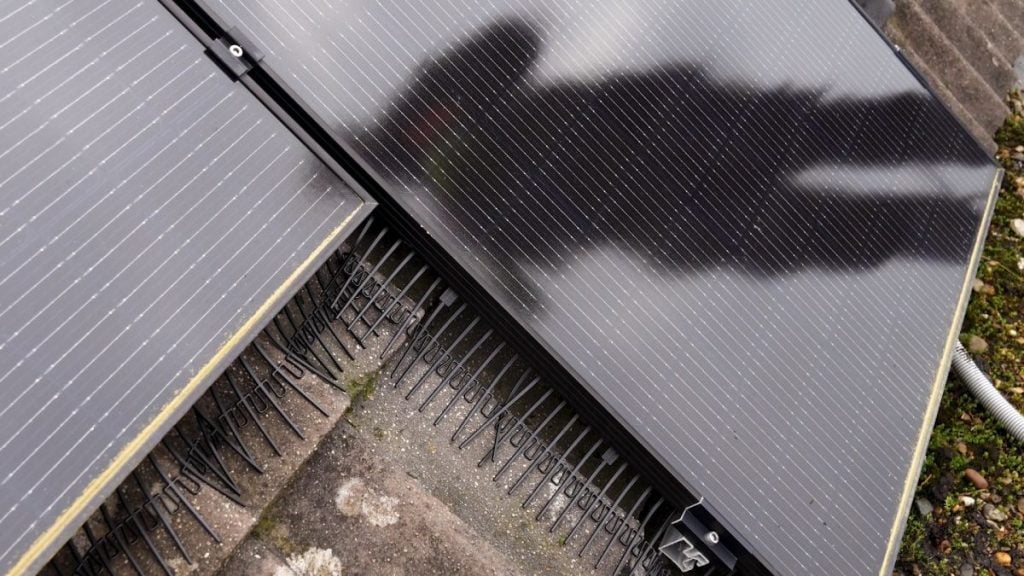
What to do: use fixing systems that are compatible with solar panels, preferably clips or fixings designed to attach to the frame without drilling it. Systems such as BirdBlocker are designed precisely to create a physical barrier without needing to drill into the panel.
Mistake 6: completely blocking lower ventilation
Solar panels need lower ventilation to dissipate heat. That is why closing the gap hermetically with solid materials, foam, closed sheets or solutions without airflow can be counterproductive.
Poor anti-pigeon protection should not only prevent birds from entering, but also respect the ventilation of the system. If the installation reduces airflow too much, it may affect the operation and performance of the panels.
What to do: choose barriers that block pigeon access without preventing air from passing through. Suitable mesh or systems specifically designed for solar panels allow the perimeter to be closed while maintaining the necessary ventilation under the panels.
Mistake 7: using cheap materials that are not suitable for outdoor use
A roof is a demanding environment for any material. Sun, rain, wind, temperature changes and constant exposure can quickly degrade low-quality plastics, standard cable ties or weak mesh.
A mesh that breaks, rusts, deforms or comes loose can stop protecting the installation in a short time. In that case, pigeons may return and the customer ends up paying twice: first for a poor solution and then for a new installation.
What to do: use materials designed for outdoor use, UV-resistant and suitable for solar installations. It is also important for the fixings to be durable and not degrade quickly under sunlight.
Mistake 8: installing mesh that is loose or too close to the roof
Poorly installed mesh can fail even if the material itself is correct. If it is loose, pigeons can push it, deform it or find an entry point. If it is too close to the roof or poorly adapted to the tiles, it can accumulate leaves, branches or dirt.
Vibrations caused by wind, barrier movement or areas where the protection loses tension over time can also appear.
What to do: the barrier must be stable, well adjusted and properly adapted to the perimeter of the panels. It should close access without touching delicate elements, without blocking drainage points and without creating areas where debris can build up.
Mistake 9: protecting only part of the installation
Another common mistake is to protect only the panels where pigeon activity has been seen, while leaving other areas of the same system open. When this happens, birds can simply move to another part of the photovoltaic installation.
Pigeons do not need to access the exact same point. If they find another available gap under a nearby panel, they are likely to continue using the roof as shelter.
What to do: assess the complete installation. If the problem affects a set of solar panels, it is advisable to close the perimeter of the entire system that could serve as shelter.
Mistake 10: not checking shadows, drainage or dirt accumulation
Poorly installed protection can create indirect problems. If it sticks out too much, it can cast shadows on part of the panel. If it blocks drainage areas, it can encourage water or dirt build-up. If it traps leaves, it can increase maintenance needs.
In solar installations, even small details can matter. The protection must prevent bird access without interfering with the normal operation of the system.
What to do: make sure the barrier does not cast shadows on the surface of the panels, does not press on cables, does not block drainage points and does not make future inspections more difficult.
Mistake 11: assuming no maintenance will ever be needed
Good anti-pigeon protection greatly reduces the problem, but it does not mean the roof will never need to be checked again. Over time, dirt may build up, a fixing may move or a weak point may appear if the installation has been exposed to wind, heavy rain or later work on the roof.
What to do: inspect the protection periodically, especially after storms or roof maintenance work. A visual inspection can help detect gaps, loose parts or debris build-up in time.
What a good anti-pigeon installation on solar panels should include
A correct installation should not simply involve placing a barrier around the panels. It must meet several criteria at the same time:
- close the entire access perimeter under the panels;
- avoid drilling into the panel frame;
- maintain lower ventilation;
- withstand outdoor conditions for years;
- remain securely fixed against wind;
- not cast shadows over the panels;
- not press on cables or connectors;
- allow future inspections and cleaning;
- have a discreet and professional appearance.
That is why, for pigeon problems underneath solar panels, the most reliable options are usually physical perimeter barriers, such as correctly installed mesh or a system specifically designed for solar panels, such as BirdBlocker.
You can view the product here: BirdBlocker for solar panels
You can also view the full category of solutions to protect solar panels from birds here: Bird Deterrents for Solar Panels
Checklist before installing anti-pigeon protection on solar panels
Before installing protection, it is worth checking the following points:
- whether there are active nests under the panels;
- whether there are droppings, branches, feathers or accumulated debris;
- whether the area can be cleaned before closing the perimeter;
- whether the solution allows lower ventilation to be maintained;
- whether drilling into the panel frame is avoided;
- whether the fixings are suitable for outdoor use;
- whether there are gaps in corners, sides or cable entry points;
- whether the protection could cast shadows on the panels;
- whether the installation can be inspected in the future;
- whether the roof requires the intervention of a professional installer.
When it is advisable to call a professional
In some simple installations, it may be possible to install protection by carefully following the manufacturer’s instructions. However, there are situations where it is safer to use a specialised professional:
- sloped or difficult-to-access roofs;
- installations at height;
- fragile or slippery roof surfaces;
- significant presence of nests or droppings;
- large solar installations;
- doubts about wiring, warranties or fixings;
- need for prior cleaning or disinfection.
Installation safety is just as important as the effectiveness of the protection. If roof access is not safe or there are doubts about how to fix the barrier, it is better to rely on a qualified installer.
Summary: what to avoid and what to do
| Common mistake | Why it is a problem | What to do |
|---|---|---|
| Using only spikes | They do not close the gap under the panels | Use a physical perimeter barrier |
| Relying only on owls or ultrasonic devices | Pigeons can get used to them | Physically block access |
| Not cleaning first | Nests, droppings and debris remain under the panels | Clean and sanitise before installation |
| Leaving gaps | Pigeons can get back in | Close the entire perimeter |
| Drilling into the frame | It can affect the panel or the warranty | Use compatible clips or fixings |
| Blocking ventilation | It can affect heat dissipation | Choose a ventilated barrier |
| Using weak materials | They degrade with sun, wind and rain | Use materials suitable for outdoor conditions |
| Not inspecting the installation | Gaps or loose parts may appear | Carry out periodic inspections |
Final recommendation
To protect solar panels from pigeons, the most important thing is to avoid improvised solutions. The goal should be to close access under the panels in a continuous, safe and ventilated way.
Spikes, ultrasonic devices or visual deterrents may be useful in other contexts, but when pigeons are getting underneath solar panels, the main solution is usually a physical perimeter barrier.
Depending on the case, suitable mesh installed correctly or a specific system such as BirdBlocker can be used. BirdBlocker is designed to protect solar panels without drilling into the panel and while maintaining lower ventilation.
You can find more information about BirdBlocker here: BirdBlocker to protect solar panels from pigeons
And the full category of solutions for this type of problem here: solutions to protect solar panels from pigeons
Frequently asked questions
Do spikes stop pigeons from getting underneath solar panels?
Spikes can help in areas where pigeons perch, but they are not usually enough to stop them from getting underneath solar panels. To prevent nests under the panels, a physical barrier that closes the perimeter is normally needed.
Should the area be cleaned before installing anti-pigeon protection?
Yes. It is highly recommended to remove nests, branches, feathers and droppings before installing the protection. If the perimeter is closed without cleaning first, dirt remains trapped under the panels and can continue to cause problems.
Can I drill into the solar panel frame to attach mesh?
It is not recommended. Drilling into the frame may affect the warranty, cause corrosion or damage the installation. It is preferable to use fixing systems compatible with solar panels, such as specific clips or solutions designed not to drill into the panel.
Can I completely close the gap under solar panels?
The gap should not be closed hermetically. Solar panels need lower ventilation to dissipate heat. The protection must stop birds from entering, but still allow air to circulate.
Can pigeons get in through small gaps?
Yes. Pigeons can take advantage of gaps in corners, sides, cable entry points or roof irregularities. That is why it is important to close the entire perimeter of the installation, not just the most visible areas.
Do ultrasonic devices work against pigeons on solar panels?
They should not be considered the main solution if pigeons are already getting underneath the panels. In that case, it is usually more effective to physically block access with a perimeter barrier.
What materials are best for protecting solar panels from pigeons?
It is advisable to use materials suitable for outdoor use, designed to withstand sun, rain, wind and temperature changes. It is also important for the fixings to be durable and compatible with the solar installation.
How often should the protection be inspected?
It is advisable to inspect the installation periodically, especially after storms, roof work or maintenance tasks. Inspection helps detect gaps, displaced parts or dirt build-up.